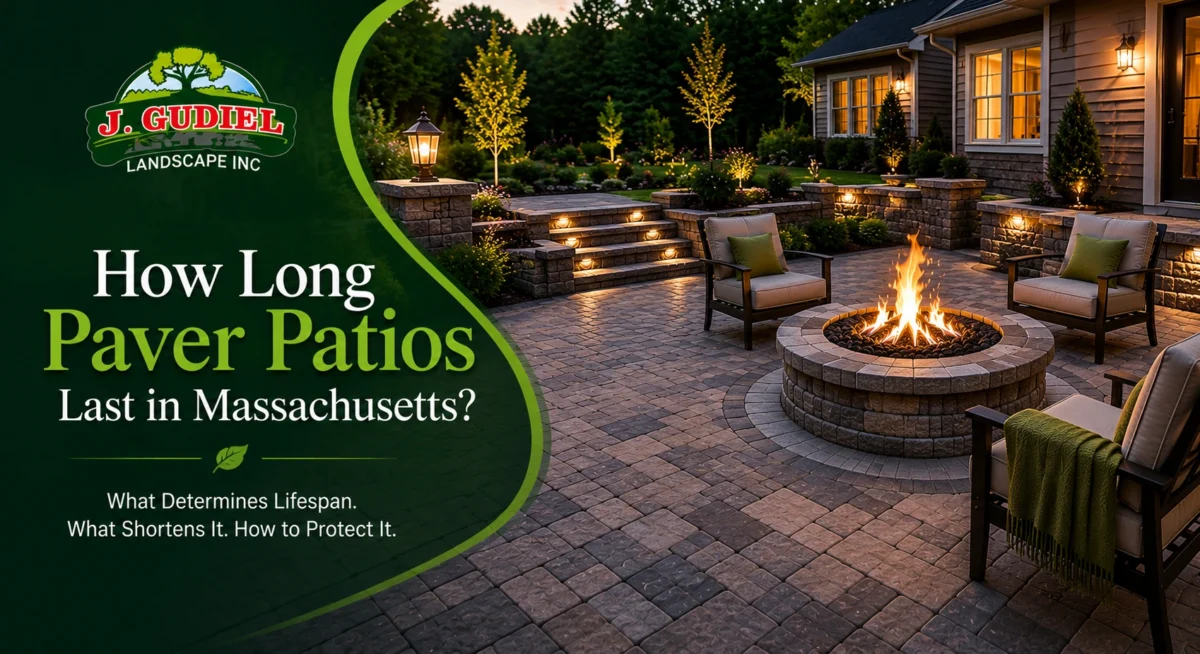
A paver patio installed correctly in Massachusetts lasts between 25 and 50 years. Concrete pavers sit in the middle of that range. Natural stone, like bluestone and granite,e sits at the top. Both outlast poured concrete slabs by a wide margin in this climate.
What separates a patio that reaches 30 years from one that fails within five has almost nothing to do with the material on top. It comes down to base preparation, drainage, and installation quality. Massachusetts winters, with clay-heavy soil and 30 to 40 freeze-thaw cycles every year, expose every weakness below the surface.
How Long Do Concrete Pavers Last?
Concrete pavers manufactured for freeze-thaw conditions have low water absorption rates and high compressive strength. This prevents internal cracking when temperatures drop below freezing. Brands like Unilock, Techo-Bloc, Cambridge, and Nicolock are tested specifically for New England conditions.
On a correctly prepared base with proper drainage, concrete pavers in this region regularly reach 30 years and beyond. Individual units can be replaced without disturbing the rest of the surface, which extends the working life further.
How Long Does Natural Stone Last?
Bluestone and granite have near-zero porosity. Freeze-thaw cycles have very little to work with at the material level because water cannot penetrate deeply enough to cause damage.
Bluestone quarried in the Northeast has been used on New England patios for generations. Granite is the most freeze-thaw resistant patio material available. Both reach 50 years or more when the base underneath is prepared correctly.
How Does Poured Concrete Compare in This Climate?
Poured concrete slabs cannot flex with seasonal ground movement. When the soil shifts beneath a monolithic slab, the slab cracks. In this climate,e that shift happens dozens of times every winter, so surface cracking is common within the first decade.
Sodium chloride de-icers accelerate surface spalling significantly. Individual repairs are visible, and cracks tend to reopen over time. This is why most hardscape work in this region uses modular paver systems rather than poured slabs.
Why the Gravel Base Determines Lifespan
For freeze-thaw conditions in this region, a compacted gravel base of six to eight inches is the correct minimum for a residential patio on established ground. On clay-heavy soil, which is standard across Bellingham and MetroWest, deeper preparation is often needed because clay drains poorly and shifts more under seasonal pressure.
The gravel needs to be compacted in three-inch lifts with a plate compactor, with each layer fully set before the next is placed. Dumping the full depth at once leaves the lower layers loose. The base shifts unevenly over time, regardless of what material sits on top.
How Drainage and Grading Affect Patio Lifespan
The standard surface slope is a quarter-inch drop per foot of length away from the house. On most Bellingham properties, a geotextile fabric layer between the native soil and the gravel base prevents clay from migrating upward and reduces drainage capacity over time.
For properties with low areas or drainage that runs toward the house, a French drain built into the installation removes water before it accumulates in the base. How each of these steps is handled during installation is covered in more detail in the patio installation quality guide.
Edge Restraints and Why They Matter
Pavers hold together through lateral pressure maintained by edge restraints at the perimeter. When restraints fail or are never installed correctly, the outermost units begin migrating outward.
Joints open. The surface becomes uneven. This failure travels inward and requires pulling up and rebuilding the affected section to correct. Correctly installed edge restraints are one of the most cost-effective steps toward a surface that holds its shape for decades.
What Shortens Patio Lifespan
Sodium chloride, the active ingredient in standard rock salt, draws moisture into concrete paver surfaces and accelerates freeze-thaw damage. Over multiple winters, this causes scaling and pitting. Calcium chloride and magnesium chloride are less damaging alternatives. Keeping joints filled with polymeric sand reduces the pathways through which salt-laden water reaches the base.
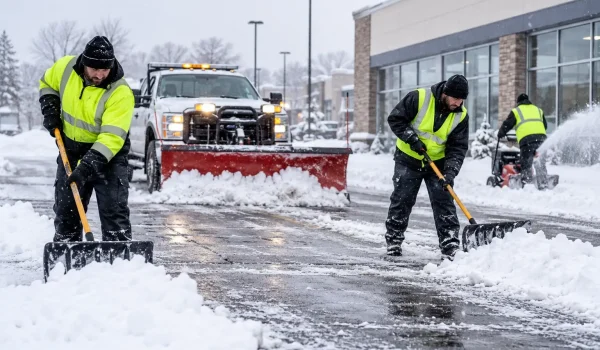
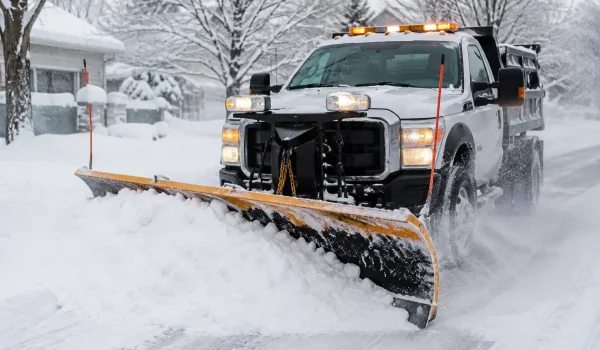
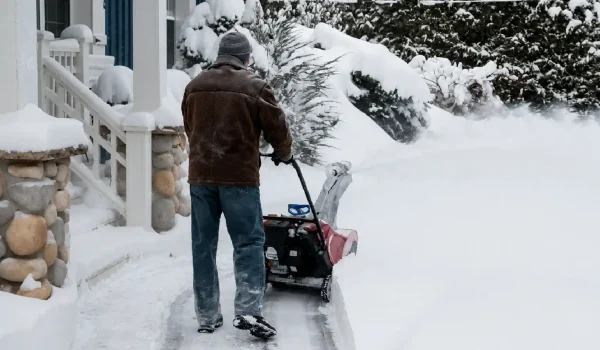
Metal shovel blades and plough edges dragged across pavers chip and crack individual units over time. Rubber-edged shovels and snow blowers with plastic paddles cause far less contact damage. For homeowners who use ploughing services, specifying blade height near the patio surface prevents damage from compounding across multiple winters.
Maintenance That Extends Patio Life
Polymeric sand locks joints and resists washout from rain and snowmelt. After hard winters, joint sand settles and thins. Inspecting joints each spring and refilling where needed prevents water from reaching the base through open gaps and discourages weed growth.
A penetrating sealer applied every three to five years on a clean, dry surface reduces moisture absorption and slows freeze-thaw degradation. For natural stone, use a product suited to the specific material. Sealing does not compensate for base problems, but on a correctly installed patio, it meaningfully extends surface life.
25 to 50 Years Is the Range. Where Your Patio Lands Depends on the Foundation.
Concrete pavers on a well-prepared base routinely reach 30 years in Massachusetts. Natural stone installed correctly lasts longer still. What pulls a patio toward the lower end of that range is almost always a shallow base, unplanned drainage, or maintenance deferred too long.
The material sets the ceiling. The foundation determines whether you reach it. Homeowners planning a patio in Bellingham or nearby communities can read more about the hardscape design and installation process on this site.
Frequently Asked Questions
How long does a paver patio last in Massachusetts? A correctly installed patio lasts 25 to 40 years for concrete pavers and 50 years or more for natural stone. Installation quality, including base preparation, drainage, and edge restraint,s is the primary factor, not the material alone.
How often do pavers need to be replaced? On a correctly installed patio, individual pavers may need occasional replacement if they crack or chip. A surface that settles unevenly or heaves consistently has a base problem, not a paver problem.
Is there a downside to sealing pavers? Sealing over moisture already in the surface causes haziness or white discolouration. It should only be done on a completely dry surface in mild temperatures using a product suited to the specific paver type. Applied correctly, it extends surface life.
What is the most low-maintenance patio material? Granite requires the least ongoing attention in this climate. Its near-zero porosity means minimal moisture absorption and high resistance to de-icing products. Concrete pavers with polymeric sand joints and periodic sealing are the most practical low-maintenance choice at a mid-range budget.
Do paver patios crack in Massachusetts winters? Pavers on a correctly prepared base with filled joints rarely crack from freeze-thaw cycles. Problems occur most often when the base is too shallow, drainage is inadequate, or sodium chloride de-icers have degraded the surface over multiple winters.
Planning a Patio in Massachusetts?
A patio that lasts starts with the right foundation. That means a gravel base built to the correct depth for this climate, drainage planned for your specific property, edge restraints installed properly around the full perimeter, and materials selected for New England freeze-thaw conditions.
Gudiel Landscape Inc. has been doing this work in Bellingham and across 30+ Massachusetts communities since 2000. Every hardscape project is built to a standard that holds up through decades of hard winters, not just the first season.
We design and install patios, retaining walls, walkways, driveways, outdoor kitchens, fire pits, and steps. Each project is managed personally from the first consultation to the final installation.