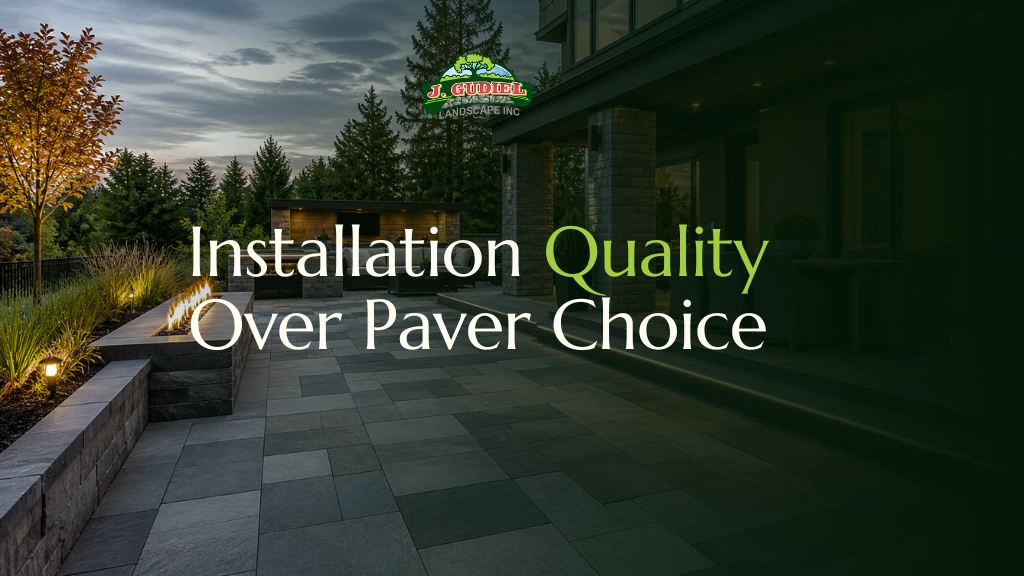
Two patios go in the same year on the same street in Bellingham. Same paver. Same design. Five winters later, one is still flat and tight. The other has cracked sections, open joints, and edges that have pushed outward.
The difference has nothing to do with the material on top. It has everything to do with what sits underneath.
New England runs 30 to 40 freeze-thaw cycles every winter. Water gets into the soil, freezes, expands, and pushes upward. It thaws, the ground drops. A gravel foundation laid correctly manages this movement. A shallow or poorly prepared one transfers it directly to the surface. The pavers get the blame. The base is what failed.
What Happens When a Patio Base Is Not Built Correctly
Water expands by approximately nine percent when it freezes. That expansion happens in all directions, including upward against whatever sits above it.
When water collects beneath a patio and freezes, the ground rises. When it thaws, it settles. Over dozens of cycles in a single winter, this movement is not uniform. Some areas freeze faster. Some hold more moisture. The result is uneven heaving across the finished surface.
A properly prepared base handles this because it is designed to drain water away before it reaches the freeze level. It also extends deep enough that ground movement happens below the structure rather than inside it. The frost line in this region sits at 48 inches. A foundation built to the right depth keeps the top layer stable while the soil below shifts through the season.
A shallow or poorly compacted base holds water, which can cause damage. Pavers push up in winter, settle unevenly in spring, and joints open over time. No surface-level repair fixes this. The problem is structural. See how we approach this on our Hardscape Design service.
How Deep Should a Patio Base Be in Massachusetts?
For freeze-thaw conditions in this climate, a compacted gravel base of six to eight inches is the correct minimum for a residential patio on established, settled ground.
On clay-heavy soil, or where significant regrading has taken place, greater depth is often needed. These conditions drain poorly and shift more under seasonal pressure.
Depth alone does not create stability. The gravel needs to be laid and compacted in three-inch lifts using a vibratory plate compactor. Each layer must be fully set before the next goes down. This creates a dense, interlocked foundation.
Dumping the full depth at once and running equipment across the top does not produce the same result. The lower layers stay loose and the foundation shifts unevenly over time, regardless of what material sits above it.
When you receive a quote, material costs are easy to compare. You can look up what Unilock or Techo-Bloc pavers cost per square foot. What is harder to evaluate from a quote sheet is the base specification. That is where the real difference between a patio that lasts decades and one that fails within a few winters comes from.
Why Drainage Matters for Patio Installation in Clay Soil
Most Bellingham and MetroWest properties sit on clay-heavy soil. Clay does not drain naturally. Water that reaches it stays rather than moving through.
Standing water in or beneath the gravel layer is exactly the condition that makes freeze-thaw damage most severe.
Proper excavation removes native soil to the correct depth and grades the subgrade for drainage. In most clay-soil situations, a layer of geotextile fabric is placed between the subgrade and the gravel. This fabric separates the two materials and prevents clay particles from migrating upward over time.
Without it, fine particles slowly work their way into the base, reducing drainage capacity and compromising the foundation from below.
For properties with low areas, drainage that runs toward the house, or consistently wet sections after rain, a French drain or perimeter drain removes water before it accumulates under the patio. It adds to the upfront cost and adds the most years to the patio’s working life on a clay-soil property.
Grading: The Step Most Commonly Left Out of Low-Bid Installations
A patio that does not slope away from the house holds water on the surface. That water works into the joints, builds up at the foundation edge, and creates freeze-thaw pressure from above.
The standard is a quarter-inch drop per foot of length. On a 12-foot-deep patio, there are three inches of fall from the house edge to the outer edge. It is not visible once the work is done, but it is what keeps water moving off rather than pooling.
This slope is set during excavation and carried through every layer of preparation. It cannot be corrected afterward without pulling the entire surface up. It is one of the most frequently skipped steps in low-bid jobs.
Edge Restraints: Why Patios Fail from the Outside In
Pavers derive their structural strength from being locked tightly under lateral pressure. The edge restraints at the perimeter maintain that pressure over time.
When restraints fail, the outermost units begin migrating outward. As they move, the pavers beside them follow. Joints widen. The top layer becomes uneven. This failure travels inward from the edges and requires pulling up and rebuilding the affected section to correct.
Restraints should be aluminum or heavy-duty plastic, driven into the compacted layer with spikes at regular intervals around the full perimeter. They should not flex when lateral pressure is applied. Getting this right costs very little extra. It requires care during installation, which is exactly why it gets skipped on jobs priced to win rather than built to hold.
Do Paver Brands Matter?
Yes, but only after the base is right.
Premium brands like Unilock and Techo-Bloc produce pavers engineered specifically for freeze-thaw conditions. Their products meet verified density and absorption standards, and Unilock in particular offers an Authorized Contractor program that holds installers to a defined installation standard. Cambridge and Nicolock are similarly tested for cold-climate performance.
But none of that protects a patio installed on a shallow base, poor drainage, or missing edge restraints. A premium paver on a bad foundation will fail. A well-specified paver on a correct foundation will last. The brand decision matters for aesthetics and surface performance. The base decision determines everything else.
If you are evaluating a project that uses these materials, ask the same questions about the base regardless of which brand is specified. The paver name on the quote sheet does not guarantee the installation standard underneath it. You can see the materials and brands we work with on our [Hardscape Design service page].
Questions to Ask Any Contractor Before Signing
Most homeowners compare quotes by price and paver selection. The questions that reveal whether a patio will still be in good condition after a decade of hard winters are the ones about what goes under the surface.
What is the base depth, and how is it compacted?
Six to eight inches of gravel, laid and compacted in three-inch lifts with a plate compactor, is the right answer for established ground in this climate. A vague response or a thinner depth means the foundation is not being prepared to what these conditions require.
How is drainage being handled?
Ask specifically how the patio is being graded, what type of gravel is being used, and whether there is a drainage plan for low areas or any spots near downspouts on the property.
What edge restraint system is being used?
Aluminum or heavy-duty plastic restraints spiked into the compacted layer around the full perimeter is the correct answer. If they are not in the scope, ask why.
How is the clay subgrade being addressed?
On a Bellingham property, or in most MetroWest towns, clay is almost always present below grade. Ask whether geotextile fabric is being placed between the native soil and the gravel. On clay, it is a standard step, not an upgrade.
The Base Is the Investment. The Paver Is the Finish.
A patio installed correctly on the right foundation holds up for 25 to 30 years. One put down on a poor base starts showing problems after the first two or three winters.
The paver determines how the surface looks. The gravel layer, drainage, compaction, and edge restraints determine whether it is still standing correctly after a decade of hard winters.
Most of what separates a patio that lasts from one that fails happens below the surface, during steps most homeowners never see. Asking the right questions before work starts is how you protect that investment. For Bellingham homeowners and across the communities served by J. Gudiel Landscape Inc., that standard has been the foundation of every project since 2000.