
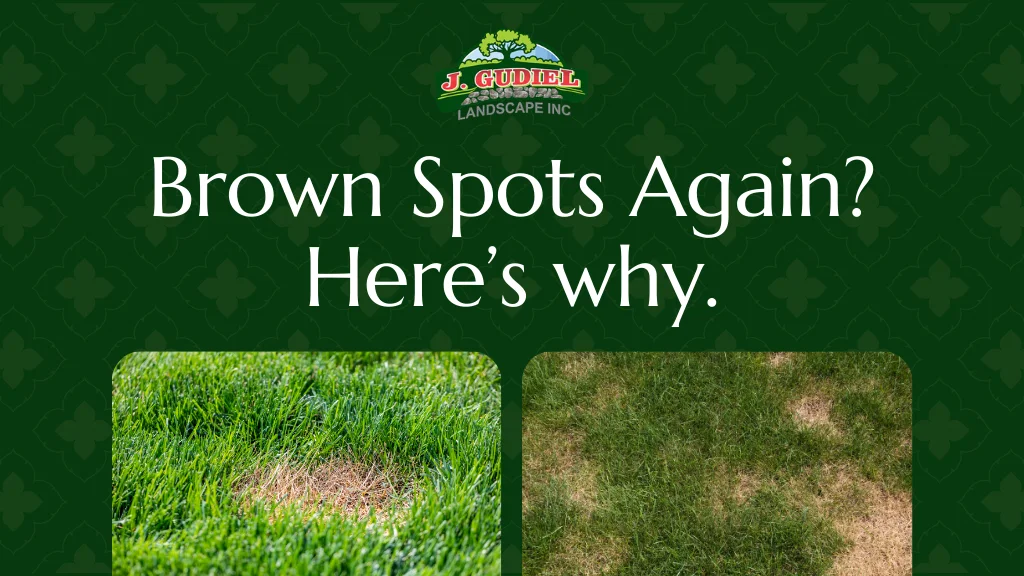
You fertilize. You water. You reseed the bare spots every fall. And yet, come July, the same patches go brown in the same places, the crabgrass fills back in along the driveway, and the lawn never quite gets to where you want it.
The problem is rarely effort. Most Bellingham homeowners put in plenty of that. The problem is that Massachusetts lawns have a specific set of challenges driven by clay-heavy soil, humid summers, hard winters, and road salt damage along property edges. Treating the surface without understanding what is driving the issue is why the same problems keep coming back year after year.
Below is a breakdown of the four lawn problems that come up most in Bellingham yards: what is causing them, how to spot them early, and what actually works to fix them on New England soil.
1. Grubs Destroying Your Grassroots from Below
Grub damage is deceptive. By the time brown patches appear in late August or September, the larvae have already been feeding on grassroots for weeks. Japanese beetle grubs are the most common culprit in central Massachusetts. The adult beetles lay eggs in lawns during June and July, the eggs hatch in late summer, and the larvae spend fall tunneling through the soil and eating away at root systems just below the surface.
The dead giveaway is how the turf feels. Pull up a section in a damaged area and it lifts almost like carpet with no resistance, because the roots holding it down are gone. You will often also notice skunks, raccoons, or birds working over patches of your lawn, which is a reliable sign that something underneath is drawing them in.
The threshold that tells you whether treatment is necessary is six grubs per square foot. Fewer than that and a healthy lawn can typically recover on its own. Six or more in a concentrated area means the infestation is actively causing damage and needs to be addressed.
What works:
- Preventative grub control applied in late spring to early summer, before eggs hatch, is the most cost-effective approach. Once larvae are established and feeding, treatment costs more and results are less predictable.
- If grubs are already present in fall, a fast-acting insecticide can reduce the population, though full recovery usually means overseeding the affected areas the following September.
- Thick, dense turf is less attractive to egg-laying beetles. Keeping your lawn well-aerated and properly seeded reduces vulnerability over time.
2. Crabgrass That Comes Back to the Same Spots Every Year
Crabgrass germinates in spring once soil temperatures consistently reach 55 degrees Fahrenheit at a one-inch depth. In Bellingham, that window typically opens between late April and mid-May depending on the season. From there, it grows aggressively through the hottest part of summer and produces as many as 150,000 seeds per plant before frost kills it in fall.
The reason it returns to the same areas year after year is straightforward. Crabgrass does not compete well against healthy, dense turf. It moves into spots where your grass is already weak: compacted clay soil near driveways, edges damaged by road salt in winter, sections that got scalped too short during mowing, and anywhere with thin coverage or bare soil. Fix those weak spots and crabgrass loses most of its entry points.
One thing worth knowing about timing: once crabgrass goes to seed in late summer, post-emergent treatment is largely pointless for that season. The seeds are already in the soil and will germinate next spring. Getting ahead of it with a pre-emergent in early spring is what breaks the cycle.
What works:
- A pre-emergent herbicide applied before soil temperatures hit 55 degrees forms a barrier that stops germination. The application window is narrow, usually late April in this area, and timing it correctly is what determines whether it works.
- Post-emergent products are effective on young plants that have not yet gone to seed. After seed heads form, skip it and focus on pre-emergent planning for next year.
- Mowing at 3 inches or taller all season keeps your turf dense enough to shade out crabgrass seeds trying to germinate in thin areas.
3. Brown Patch and Red Thread Fungal Disease
Two fungal diseases show up regularly in Bellingham and MetroWest Massachusetts lawns, and both get misread as drought damage or fertilizer problems. Knowing which one you are dealing with changes how you respond.
Brown patch
Brown patch develops during stretches of hot, humid weather when daytime temperatures stay above 80 degrees and nighttime temperatures hold above 65 degrees. It shows up as roughly circular tan or brown areas, anywhere from a few inches to several feet across, and spreads quickly when the grass surface stays wet overnight. Tall fescue and perennial ryegrass are particularly susceptible. Evening watering, poor drainage, and heavy nitrogen applications right before a heat wave all create conditions where brown patch spreads fast.
Red thread
Red thread tends to appear in the cooler, wetter parts of the growing season, particularly late spring and early fall in New England. The identifying sign is pinkish-red thread-like strands on grass blades, with the surrounding turf going tan and ragged. Where brown patch is a moisture and heat problem, red thread is almost always a nitrogen deficiency problem. Turf that is not getting fed consistently cannot grow fast enough to stay ahead of the fungus.
What works:
- Water in the morning so grass blades have the full day to dry out. Evening watering is one of the leading causes of fungal disease in this region and is an easy habit to change.
- Avoid applying quick-release nitrogen fertilizers right before a hot, humid forecast. Slow-release formulas throughout the season are better for both nutrition and disease resistance.
- For red thread, a balanced fertilizer application in early fall typically clears the problem without needing fungicide. The grass just needs to be fed well enough to outgrow it.
- Fungicide is available for active outbreaks but does not change the conditions that caused the disease. Cultural habits are what prevent it from returning.
4. Thin, Patchy Turf That Does Not Respond to Fertilizer
A lawn that stays thin and patchy despite regular fertilizing is almost always a soil issue, not a grass issue. Most Bellingham properties have acidic soil with pH levels sitting between 5.5 and 6.0. Cool-season grasses need pH closer to 6.5 to 7.0 to absorb nutrients properly. Below that range, nitrogen, phosphorus, and potassium become chemically locked in the soil. You can apply fertilizer on schedule all season and the grass still cannot access it.
Clay compaction makes this worse. Compacted soil limits root depth, reduces water absorption, and blocks new seed from establishing contact with the soil below. Homeowners in this situation often spend years cycling through different fertilizer products looking for something that works, without realizing the soil chemistry is blocking everything they put down.
A soil test from UMass Extension removes all the guesswork. It tells you your exact pH, which nutrients are deficient, and how much lime is needed to bring the soil into the right range. Lime takes three to six months to adjust pH, which is why fall is the right time to apply it in Massachusetts.
What works:
- Get a soil test before spending more money on fertilizer. Treating without knowing your soil numbers is guessing.
- Apply lime in fall based on soil test results to correct acidity over the winter before spring growth begins.
- Core aeration breaks up compaction and opens the root zone to nutrients, water, and new seed.
- Overseed with a Northeast-appropriate seed blend in September after aeration, giving new grass a full season to establish before summer stress arrives.
The Right Diagnosis Changes Everything
Most lawn problems in Bellingham trace back to the same underlying issues: soil that is too acidic, compaction cutting off the root zone, timing that misses the treatment window by a few weeks, or surface symptoms being treated while the real cause goes unaddressed underground. Getting the diagnosis right is what makes the difference between fixing the problem and repeating the same cycle next season.
Your Lawn Is Telling You Something. We Know How to Listen.
Brown patches, thin grass, weed takeovers. These problems do not fix themselves. The longer they sit, the more ground you lose heading into the next season.
J Gudiel Landscape has worked on Bellingham lawns for over 20 years. We have seen every problem on this list and know exactly what it takes to fix them on Massachusetts soil.
Call or text 508-380-0048 for a free lawn evaluation. We will tell you what is going on and what it takes to fix it.